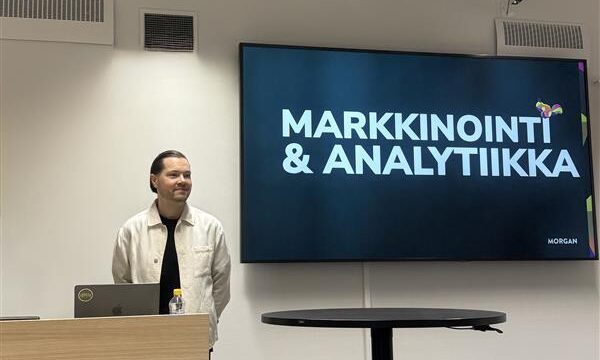
More data is available than ever before, yet the real challenge in marketing is not the amount of information but how it is utilized. How can analytics be turned into actionable insights that genuinely support decision-making? These questions were addressed last Thursday at the University of Vaasa during the course Marketing Analytics and Data Visualization, when we had the pleasure of welcoming Mikko Niiniketo as a guest lecturer.
During the lecture, Niiniketo explored the role of marketing analytics and data through practical examples drawn from both his current and previous professional roles. His presentation illustrated how analytics accompanies marketing campaigns at different stages and how data can be effectively used to support decision-making. In addition to offering new perspectives, the lecture provided students with an inspiring career story and a valuable glimpse into the realities of everyday marketing work.
Mikko Niiniketo currently works as Client Director at Morgan Digital Oy. His career path includes work on a wide range of projects in various roles. Niiniketo is also an alumnus of the University of Vaasa and has previously worked with the university as a lecturer, project researcher, and project manager.
Analytics is not a standalone tool but an integral part of the decision-making process at all levels. In organisations, marketing activities typically operate on three levels: strategic, operational, and campaign-based. The same structure applies to analytics, with each level playing a distinct role. The strategic level largely determines what is measured, while the operational level and campaigns generate the data to be analysed. According to Niiniketo, there have also been situations where campaigns have deliberately deviated slightly from the company’s overall strategy. Such campaigns offer opportunities to experiment, for example with visual identity or key messages, allowing companies to present themselves in a different style.
What, then, are the most common mistakes organisations make when using analytics? According to Niiniketo, the time frame is often a major stumbling block. Results are expected within a week, and when this does not happen, reactions are made too quickly—sometimes for example by prematurely ending a campaign. A more effective approach would be to wait, for example, a month, after which the results can be reviewed and interpreted to inform decisions about whether and how a campaign should continue. Niiniketo has adopted the Deming wheel model into his own work style, and using it comes naturally to him. According to the model, you progress through the following steps: plan, do, check and act, and this can be repeated over and over again.
Another common source of error in analytics is measuring the wrong things, focusing on irrelevant metrics, or over-analysing data. Metrics such as impressions, clicks, and likes are often discussed—but are they truly meaningful? Niiniketo notes that these metrics are frequently relied upon too heavily and often provide limited useful insight. However, this should not be misunderstood: in some cases, broad visibility is indeed a valid objective, and when the goal is specifically to increase awareness, likes and impressions may offer indicative information. Data should never be interpreted in isolation without considering its context. Contextualisation plays a crucial role in making analytics meaningful.
Key Takeaways from Mikko Niiniketo:
|
Artificial intelligence and automation have significantly facilitated the processing and structuring of large volumes of marketing data. However, Niiniketo emphasises the importance of authenticity and the growing critical awareness of audiences regarding the content they consume. It quickly becomes apparent whether content has been created by a human or by AI. Moreover, AI lacks experiential knowledge from similar past situations and does not possess insight into information that is not available in data sources. For these reasons, AI functions best as a supportive tool in analytics, while final interpretation and decision-making continue to require human expertise.
For small and medium-sized enterprises (SMEs), Niiniketo highlights that data-driven management is not exclusive to large organisations. Analytics can and should be utilized by companies of all sizes and across all industries. Another key message is the importance of websites, particularly for B2B companies. Websites serve as a company’s most important business card, strongly shaping perceptions of the organisation and, in certain situations, even elevating it to a new level. Niiniketo also recommends focusing on developing one aspect at a time, making it easier to identify the impact of changes and assess whether development efforts truly add value.

For future marketing professionals, Niiniketo encourages courage in pursuing areas and industries of genuine interest, even when already working in another role. Crossing boundaries between industries enhances expertise and is a significant strength, as it enables professionals to view challenges and opportunities from multiple perspectives.
Thank you to Mikko Niiniketo for an inspiring and thought-provoking guest lecture!