
Lisa Wätzold, Antti Mäenpää, Johanna Kalliokoski, Helka Kalliomäki
Published on March 10, 2026.
Europe has entered an era where geopolitics shapes industrial development. Russia’s invasion of Ukraine, growing tensions in global supply chains, and escalating energy insecurity have forced governments to rethink how and where critical industries are built. In the past, industrial policy was dismissed as outdated, interventionist, and economically inefficient1. Today, it increasingly becomes a tool for countries striving to secure clean energy, critical technologies, and resilient supply chains.
Over the past decade industrial policy has returned to practice, and advanced economies in Europe and North America started to introduce large-scale subsidies and targeted support measures2. Due to geopolitical, economic and sustainability pressures, these interventions are now tied to wider objectives related to green transitions, technological autonomy, supply chain resilience, and national security3. Especially in Nordic economies these objectives accelerate the need for regionally grounded and internationally coordinated industrial strategies.
Research: Bridging Strategic Spatial Policies and Returning Industrial Policies for Innovation and Growth (STRAIND)
The STRAIND project highlights that strategic reindustrialisation necessitates a comprehensive understanding of place-based innovation potential, resilience, and the spatiality of threats and opportunities of industrial renewal. In addition to strategic spatial (re)positioning in changing operational and security environments, it is expected that returning industrial policies make bold choices in their strategies building on place-based strengths and potential. Although the definition of industrial policy in literature has broadened to include wider objectives, spatial implications are often treated implicitly.
Spatial and place-based approaches to industrial development emphasise regional capabilities, yet they rarely integrate security aspects and supranational coordination4. Altogether, a strategic perspective to spatial dimensions in industrial policy remains underspecified, especially in times of geopolitical instability. In practice, reindustrialisation is inherently geographical as policy choices shape where production systems, innovation activities, and industrial capabilities establish, and outcomes are again conditioned by territorial factors.
Accordingly, the STRAIND project assesses how returning industrial policies in a geopolitically unstable environment reshape international competition, value chains, and more specifically Finland’s ability to attract foreign investment. This includes an investigation of the tools small open economies like Finland need to succeed in a volatile environment. Consequently, there is the question of long-term implications for emerging technologies in Finland. Lastly, these trends will likely have an impact on the green transition as it is open whether sustainability will be side-lined in favour of defence and dual-use priorities.
Linking ecosystems, production and place
European value chains (EVC’s) showcase how re-industrialisation can be reinforced through innovation and production value enhancement by implementing regional development and strategic spatial planning perspectives. In literature on innovation policy, spatiality is recognised as a relevant factor for innovation due to, for instance, place-based capabilities of regions. From this perspective, innovation policy can be seen as a spatially anchored system building in which industrial policy supports via targeted capability upgrades and cluster formation5.
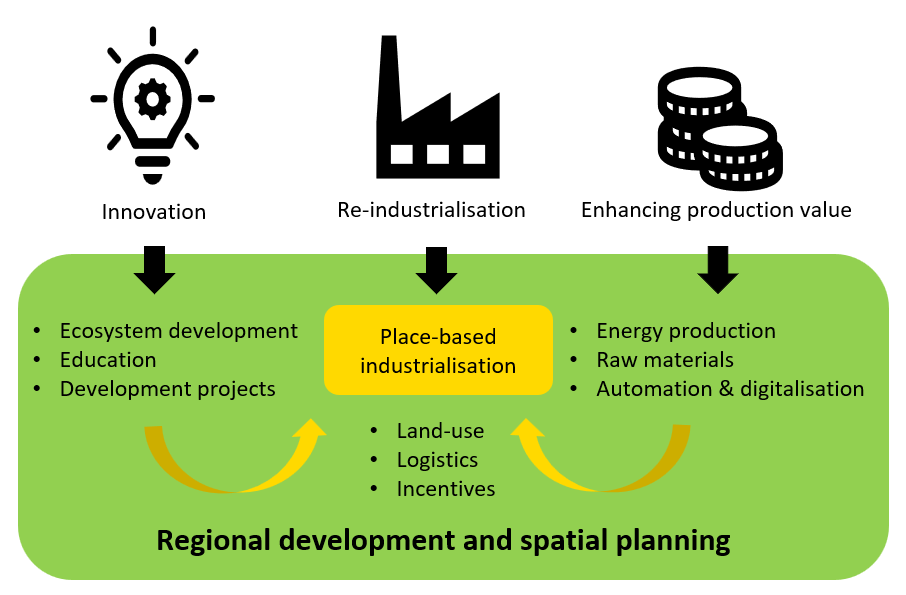
The figure above shows that innovation is driven by ecosystem development and education. Simultaneously, production value is enhanced through optimisation of the costs concerning energy production, raw materials usage, automation and digitalisation. These factors are geographically based, materialising in certain places. To advance re-industrialisation, additionally issues of land-use, logistics and incentives become important factors for regional industrial transitions. Spatially strategic industrialisation needs a mix of ingredients targeting areas from education to digitalisation and AI. If interventions in these areas are implemented in a spatially strategic manner, it will also benefit national competitiveness in Finland and the Nordics.
How place-based industrialisation builds national competitiveness
- Finland’s most competitive and sustainable capabilities are concentrated in regional ecosystems. These regional ecosystems are globally significant hubs that contribute to Finland’s export revenues, R&D leadership, and energy security.
- New industrial policy relies heavily on renewable energy, and regions play a decisive role in implementing the green transition amid external disruptions. National climate targets and industrial renewal depend on successful implementation at the regional level.
- A regional approach strengthens national industrial policy by enabling the prioritisation of strategic sectors in which Finland can achieve global leadership, grounded in region-specific competitive advantages. However, new foresight tools to support smart specialisation are needed to support industrial policy development in a volatile operational environment.
- Through co-financing and risk sharing mechanisms, innovation partnerships, and EU programmes, regions act as integrators of the EU’s industrial strategy and Finland’s national interests. However, local investments need to be aligned with national and European objectives to advance impact-driven governance from a place-based perspective.
- By embedding industrial transformation into local labour markets and infrastructure, the regional level becomes a key facilitator of the new industrial policy. Regions shape the conditions for business success by developing skills, logistics, permitting processes, and partnerships. Regional capabilities to attract and retain skilled labour, build physical infrastructure, and implement pilot projects or testing platforms are in key role for national competitiveness.
- A place-based perspective to new industrial policy supports legitimizing national policy goals and strategic competition agendas in times of tensions. As diverse regional capabilities and strengths need to be harnessed both for national competitiveness and comprehensive security, local and regional actors play key roles in building legitimacy of industrial transitions for example through citizen engagement.
Moving forward, the success of industrial policy in the Nordics will be defined by the ability to strategically align green transitions, security demands, and technological leadership with spatial characteristics of regions. The STRAIND project proposes new strategic tools that help identify where Finland can lead, where Nordic vulnerabilities lie, and how regions can accelerate renewal. As global disruptions intensify, our work will increasingly focus on scenario-based policy design, anticipatory governance, and long-term regional competitiveness.
References
2Choi, J., & Levchenko, A. A. (2025). The long-term effects of industrial policy. Journal of Monetary Economics, 152, 103779. https://doi.org/10.1016/j.jmoneco.2025.103779
4Criscuolo, C., Gonne, N., Kitazawa, K., & Lalanne, G. (2022). An industrial policy framework for OECD countries: Old debates, new perspectives. https://www.oecd.org/content/dam/oecd/en/publications/reports/2022/05/an-industrial-policy-framework-for-oecd-countries_233e3061/0002217c-en.pdf
2Evenett, S., Jakubik, A., Martín, F., & Ruta, M. (2024). The Return of Industrial Policy in Data.
3Grossman, G. M., & Sykes, A. O. (2025). Industrial Policy and Subsidies: Assessment of Current Rules and Possible Reforms. Journal of World Trade, 59(4). https://kluwerlawonline.com/api/Product/CitationPDFURL?file=Journals\TRAD\TRAD2025030.pdf
3Juhász, R., Lane, N., & Rodrik, D. (2024). The New Economics of Industrial Policy. Annual Review of Economics, 16(1), 213–242. https://doi.org/10.1146/annurev-economics-081023-024638
1Naudé, W. (2010). Industrial policy: Old and new issues.
4Rodríguez-Pose, A. (2018). The revenge of the places that don’t matter (and what to do about it). Cambridge Journal of Regions, Economy and Society, 11(1), 189–209. https://doi.org/10.1093/cjres/rsx024
5Soete, L. (2007). From Industrial to Innovation Policy. Journal of Industry, Competition and Trade, 7(3), 273–284. https://doi.org/10.1007/s10842-007-0019-5